How to collect training feedback that improves your courses

Training feedback is any information you collect from your learners, managers and customers to evaluate the quality and impact of a training programme. For training providers, it serves two purposes at once: improving your courses and proving value to the organisations that paid for them.
Most training providers send a five-question form at the end of every course, skim the averages, and call it done. The result: courses that never meaningfully improve, customers who feel unheard, and nothing concrete to point to when a contract comes up for renewal.
In this guide, we cover what good training feedback actually looks like, how to collect it at the right moments across the learner journey, and how to close the loop so it leads to tangible change in your courses and in your customer relationships.
Why feedback works differently for training providers
Internal L&D teams collect feedback to report upward: to HR, to senior leadership, to justify headcount or budget. The audience is internal and the stakes, while real, are largely organisational.
As a training provider, you’re working under a different set of pressures. The feedback you collect does two things at once:
It tells you whether your programme is working; and
It either proves the value of that programme to the customer who paid for it, or it doesn’t
That commercial dimension changes everything: what you ask, when you ask it, and what you do with the results. If you build a feedback system that captures the right evidence and shares it with customers, you’re not just running better courses. You’re giving people a reason to rebook.
The four types of training feedback worth collecting
The classic Kirkpatrick model describes four levels of training evaluation. For your purposes as an external provider, it’s more useful to think of these as four types of feedback each answering a different question, for a different audience, at a different point in time.
1. Reaction feedback: “Did your learners enjoy it?”
Reaction feedback is collected within 24 hours of course completion. It’s the most common type and the most over-relied on.
A post-course survey covering content quality, facilitator rating, pacing, and platform usability tells you whether learners had a good experience. That matters. It surfaces obvious problems quickly, generates testimonials you can use as social proof, and gives learners a sense of being heard.
What it can’t tell you is whether any learning actually happened. Satisfaction and retention are not the same thing. A course can score 4.8 out of 5 and still leave learners unable to apply anything the following week.
Recommended timing: Within 24 hours of course completion.
Recommended length: 5-8 questions maximum.
2. Learning feedback: “Did knowledge actually stick?”
Learning feedback measures the gap between what your learners knew before the training and what they can recall after it. It requires a pre-assessment for a baseline, a post-assessment for immediate recall and a retention check two to four weeks later.
This is the type most training providers skip. It’s also the one customers tend to ask about when they want to know whether the training “worked.”
Research on the spacing effect consistently shows that a single post-course score tells you about recall on the day, not what actually stays with your learners over time. Studies suggest spaced repetition can improve long-term knowledge retention by up to 80% compared to massed practice. A retention check two to four weeks after delivery is where that difference becomes visible.
If your platform includes tools like MemoTrainer for spaced repetition, this data is already being generated. You just need to build it into your feedback loop.
Recommended timing: Immediately post-course (assessment) plus 2-4 weeks later (retention check).
3. Behavioural feedback: “Did it change how your learners work?”
Behavioural feedback is the hardest to collect but the most commercially valuable.
You can gather it through manager surveys or structured follow-ups sent four to eight weeks after training, asking whether learners have applied what they learned on the job. For example, ask about their communication skills after conducting a soft skills training. Only 26% of L&D professionals say they measure the long-term impact of training on job performance which means this kind of evidence is genuinely rare, and genuinely differentiating when you have it.
Even a short three-question manager survey can produce compelling proof. In external training, this is often the evidence your customer uses when deciding whether to rebook. “Our managers noticed a measurable change in how the team handles customer calls” is a rebooking argument. “Learners rated the course 4.6 out of 5” is not.
Recommended timing: 4-8 weeks post-training.
4. Customer-level feedback: “Was this worth the investment?”
This is the feedback type that internal L&D articles rarely cover, because internal L&D doesn’t have external customers.
The person who commissioned the training programme (e.g., the HR director, operations manager, or L&D lead at the customer organisation) has a completely different perspective from the learners. Their question isn’t “Did I enjoy the session?” It’s "Did this deliver what I needed, and would I buy it again?”
A brief quarterly check-in (an NPS score plus two or three open questions) captures satisfaction at the relationship level. It surfaces strategic needs before they become problems and signals renewal intent early enough for you to act on it. customers who feel genuinely consulted are far more likely to rebook than customers who only receive an invoice.
Recommended timing: Quarterly, or after each programme delivery.
Don’t wait for feedback to find learning design issues
If there’s a design flaw in your programme, feedback will surface it eventually… but only after your learners have already experienced it. The Learning Scan helps you spot design gaps before they show up in your data.
When to collect training feedback (and why timing matters as much as the survey itself)
The best survey sent at the wrong moment can get ignored, skimmed, or completed with answers that don’t reflect what your learners actually experienced.
Here's the full timing cadence and the reasoning behind each window:
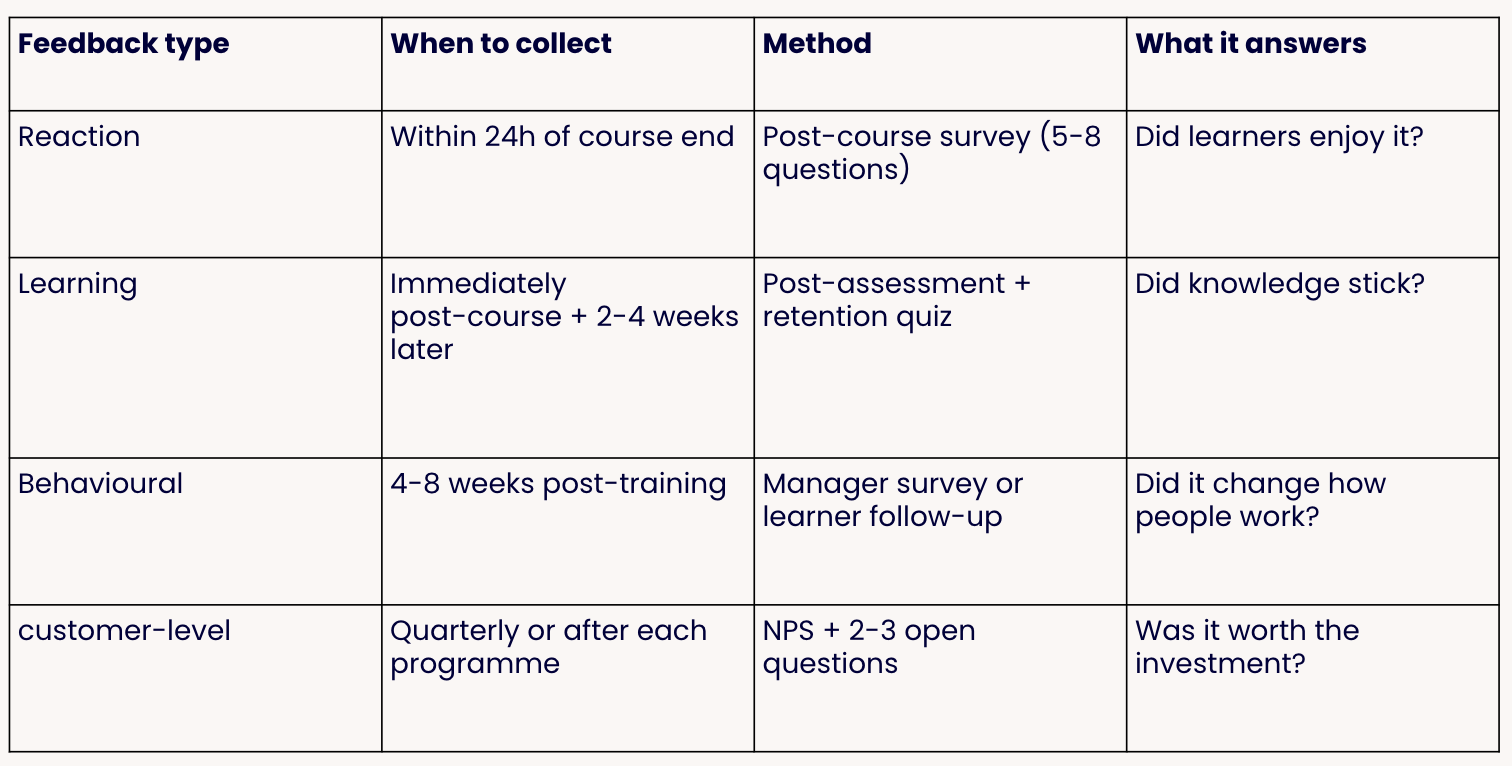
Why the 24-hour window matters: Emotional recency means learners rate their experience based on how they feel right now. Wait a week, and you get more considered responses but also answers shaped by what happened after the course, not during it. If you want genuine in-the-moment feedback, get it within 24 hours.
Why retention checks need a gap: Forgetting curves are real. The 2-4 week window is enough time for the initial post-training glow to fade, so what you’re measuring is genuine long-term recall and not just what learners could answer on the day.
Why behavioural feedback needs more time: You can’t measure behaviour change at week one. Learners haven’t had enough opportunity to apply anything meaningfully. Four to eight weeks is the minimum to ask managers or learners whether training has translated into on-the-job change.
5 Best practices to design a training feedback survey people actually complete
Most post-course survey go unanswered. The usual reasons: the survey is too long, the questions are too vague, or it arrives at the wrong moment.
Here’s a few principles to improve your chances of getting useful responses:
Keep it to 5-8 questions
Completion rates drop sharply beyond that. If you have more questions, spread them across your timing windows instead of a single end-of-course form that takes ten minutes to finish.
Mix rating scales with one open question
Scaled responses (1-5) are easy to answer and easy to aggregate across cohorts. One well-placed open question (“What would you change about this programme?”) can surface the specifics you need to improve your training.
Use plain language
“Overall, how satisfied were you with today's session?” performs better than “Please evaluate the extent to which the programme met your learning objectives.” Straightforward questions get honest answers.
Explain why you're asking
Just one sentence like “Your answers help us improve this programme for future learners” can meaningfully increase completion. People respond when they believe the feedback will actually be used.
Make it mobile-friendly
If learners need to open a laptop to find and complete your survey, most won’t. A survey embedded directly in the learning platform will always outperform an external link that requires a separate login.
If you don’t know where to start, here are three questions every post-course survey should include:
How would you rate this programme overall? (1-5)
What was most useful to you?
What would you change?
That’s enough to spot problems, gather proof points and get concrete improvement suggestions (and all of it in under three minutes).
How to act on training feedback and close the loop
Collecting feedback is the easy part. Closing the loop is what separates training providers who feel like genuine partners from those who feel like vendors.
A simple framework that works:
1. Review feedback within one week of delivery
Leaving it longer means the detail fades and the urgency goes with it. Make a weekly feedback review part of your delivery rhythm instead of leaving this for a quarterly task.
2. Identify one concrete change per course per quarter
You don’t need to act on everything at once. Pick the most actionable insight from the last cycle and change it. One specific improvement per quarter, done consistently, adds up to a meaningfully better programme over a year.
3. Tell customers what you changed
This is the step most providers skip, and it’s the highest-leverage move available to you. A short note to the commissioning customer (like “Based on feedback from your cohort, we’ve revised the module on X and restructured the final session”) demonstrates responsiveness in a way that satisfaction scores never can. It also opens a conversation about what comes next.
4. Use aggregated data to make bigger decisions
Individual responses tell you about individual experiences. Responses aggregated over time tell you something more useful: whether a facilitator consistently underperforms on certain metrics, whether a module always scores poorly for knowledge retention, whether a particular course format fails to produce behavioural change at six weeks. That’s the level of insight that turns training feedback from a compliance exercise into a product development process.
Automate your training feedback collection with aNewSpring
Running a full feedback programme across multiple cohorts, customers and delivery formats by hand creates significant overhead. The survey tool is in one place, assessment data is in another, customer reporting is manual, and chasing non-responders eats into your delivery time.
A platform that integrates feedback collection into the learning journey removes most of that friction. With aNewSpring, post-course surveys are triggered automatically based on conditions you set, MemoTrainer handles spaced repetition quizzes without you needing to schedule them manually, and trainers get an overview of completion rates and assessment scores while survey results stay accessible in one place. The collection side runs without constant manual effort. So you still handle the analysis and action, but you’re not having to chase data across separate tools.
aNewSpring is built specifically for training providers, so the data it surfaces is designed to feed into client reporting directly. Completion rates, knowledge gain scores, and learner satisfaction results are all there. With a bit of assembly, you can put together a report that gives clients a clear picture of what their cohort achieved, which is a different commercial conversation from sharing a single course average.
That’s the difference between being a vendor and being a partner.
Curious what this looks like for your training programmes? Book a free demo and we’ll walk you through it.
Frequently asked questions about collecting training feedback
What is the best way to collect feedback from training participants?
The most effective approach is to collect feedback at multiple points, not just at the end of the course. Use a short post-course survey (5-8 questions) within 24 hours for immediate reaction, a retention check at 2-4 weeks for knowledge, and a follow-up at 4-8 weeks for behavioural impact. Surveys embedded in your learning platform will always outperform external links since your learners are already there and completion requires no extra steps.
How do you measure the effectiveness of a training programme?
Effectiveness is best measured across four dimensions: learner satisfaction, knowledge gain (pre/post assessment), knowledge retention (a check-in at 2-4 weeks), and behavioural application (a manager survey at 4-8 weeks). Relying on satisfaction scores alone tells you whether learners enjoyed the experience, not whether it changed how they work. For external training providers, customer-level feedback adds a fifth layer: whether the programme was worth the investment from the buyer’s perspective. For a broader view of which metrics matter, see our guide to training provider metrics.
How often should you collect feedback from training participants?
At a minimum: once immediately post-course (reaction), once at 2-4 weeks (retention), and once at 4-8 weeks (behavioural change). For multi-module programmes, build in mid-programme check-ins as well. The goal isn’t to send more surveys, it’s to collect the right type of feedback at the moment when it’s most accurate. customer-level feedback (from the commissioning organisation) should run quarterly at minimum, separately from your learner-level surveys.